In Part 1 of this newsletter, we examined how different ways of defining ultra-processed food (UPF) place varying emphasis on processing, formulation and healthfulness, and what current evidence does and does not tell us about UPFs and health. In Part 2, we consider the practical implications: what a federal definition could incentivize, how companies can prepare for multiple plausible policy outcomes, and what this means for product development, personalized nutrition and innovation.
What the evidence means for policy and industry.
For policymakers, the definition needs to be practical for implementation and recognize that UPF status alone does not fully capture the characteristics associated with health outcomes. Relying too heavily on individual ingredients or processing markers could result in reformulation without improving food structure or eating behavior, while discouraging ingredients or technologies that provide useful nutritional or functional benefits.
For food, nutrition, and ingredient companies, the uncertainty itself requires preparation. Federal policy is evolving; states are beginning to enact and propose their own UPF definitions and restrictions, scientific and professional organizations are weighing in, and consumer expectations are changing. Companies need to consider not only whether a product may be classified as UPF, but also how that classification could affect formulation, procurement, labeling, and marketing.
Personalized nutrition challenges a one-size-fits-all approach.
Improving products is rarely as simple as changing an ingredient list. Foods must taste good, fit household budgets, remain safe and stable, be convenient, and be feasible to manufacture and distribute. Personalized nutrition makes these trade-offs especially important. Foods for older adults may need greater protein density or modified textures; metabolic health products may use specific fibers, protein isolates, or alternative sweetening approaches; and fortified, sports, or medical nutrition products may require stabilization, emulsification, or encapsulation. The technologies that help a product meet an individual's needs can also increase the likelihood that it is classified as UPF.
The same tension applies to food-as-medicine approaches, where foods may be designed for specific health risks or nutritional needs and integrated into healthcare delivery. The relevant consideration is not degree of processing alone, but whether the product delivers meaningful health benefits for the people it is intended to serve. This does not justify automatic exemptions; it means the value and consequences of processing depend on the product, consumer, and intended outcome.
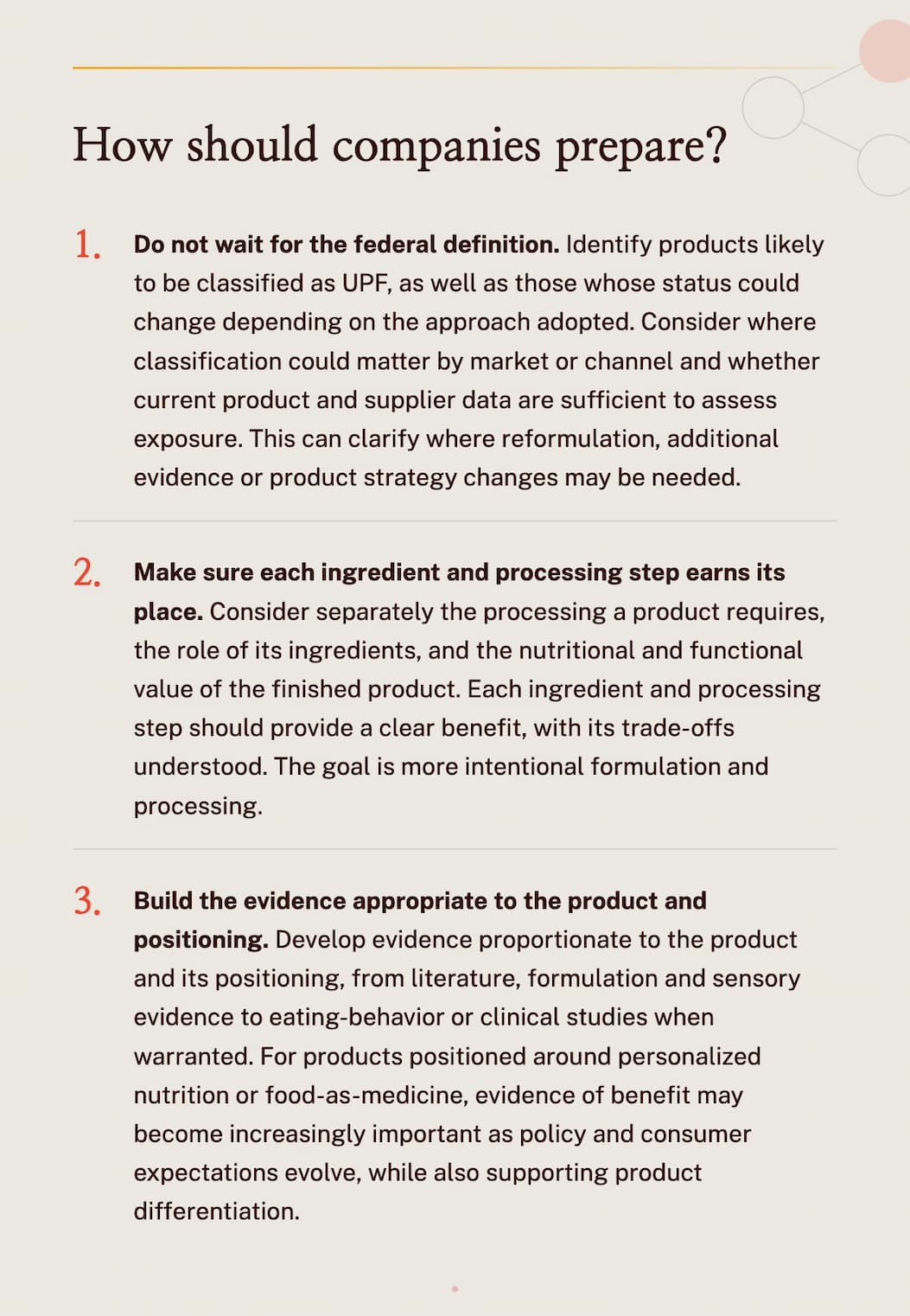
The opportunity is to build better foods, not simply fewer UPFs.
A federal definition is needed. Greater clarity can help avoid a patchwork of state-by-state definitions and regulations. But a definition that is too broad or insufficiently nuanced could encourage companies to formulate to a classification rather than improve products in ways that meaningfully support health. One that is too permissive risks accomplishing very little.
The UPF debate is prompting more rigorous examination of which food characteristics influence health, how they interact, and how food science can improve them. For food, nutrition, and ingredient companies, the opportunity is to move beyond reactive reformulation toward products designed around nutritional value, consumer needs, and measurable health outcomes. Ultimately, progress should be measured by whether more people have realistic access to foods that help them make better choices and live healthier lives.
At Nlumn, we help food, nutrition, and ingredient companies navigate evolving policy, nutrition science, and consumer needs. We identify where portfolios may be affected, where reformulation can create meaningful value, and where emerging science can open opportunities for innovation and personalized nutrition. If your organization is assessing portfolio exposure, reformulation priorities, or innovation strategy in the changing UPF landscape, we would welcome the opportunity to help.