Engagement remains one of digital health’s biggest challenges. Industry benchmarks suggest that fewer than 5% of health app users are still active 30 days after downloading an app. In response, companies have increasingly adopted features familiar from social media, including streaks, badges, leaderboards, communities, and a steady stream of content.
But are these the features that actually keep people coming back?
Earlier this month, Nlumn CEO Josh Anthony took the stage at Food HealthTech Live in New York City to share findings from our new consumer research exploring what drives repeat engagement across social media and health apps in 294 U.S. consumers who use social media and have experience with health and wellness apps.
The findings challenge some common assumptions about social media’s advantages and reveal surprising strengths for health apps. They also highlight important opportunities for companies to design personalized digital health and wellness experiences that people not only return to but also genuinely benefit from.
Health Apps Are Doing More Right Than We Think.
Surprisingly, our research suggests that health apps may already have an advantage in delivering many of the benefits consumers value despite social media’s reputation for keeping users engaged.
When comparing the two experiences, consumers rated health apps significantly higher for perceived accuracy and trustworthy information, personally relevant guidance, motivation, and long-term benefits. Despite social media’s reputation for entertainment and community, it did not significantly outperform health apps on either dimension.
These findings suggest that the opportunity may not lie in adding more features or entertainment but in better leveraging the strengths health apps already possess to encourage continued use.
If health apps already offer valued benefits, what is social media doing differently to encourage return?
Social Media's Advantage: Effortless Value and the Pull to Return
Our research identified three behaviors that may help explain social media's ability to draw consumers back:
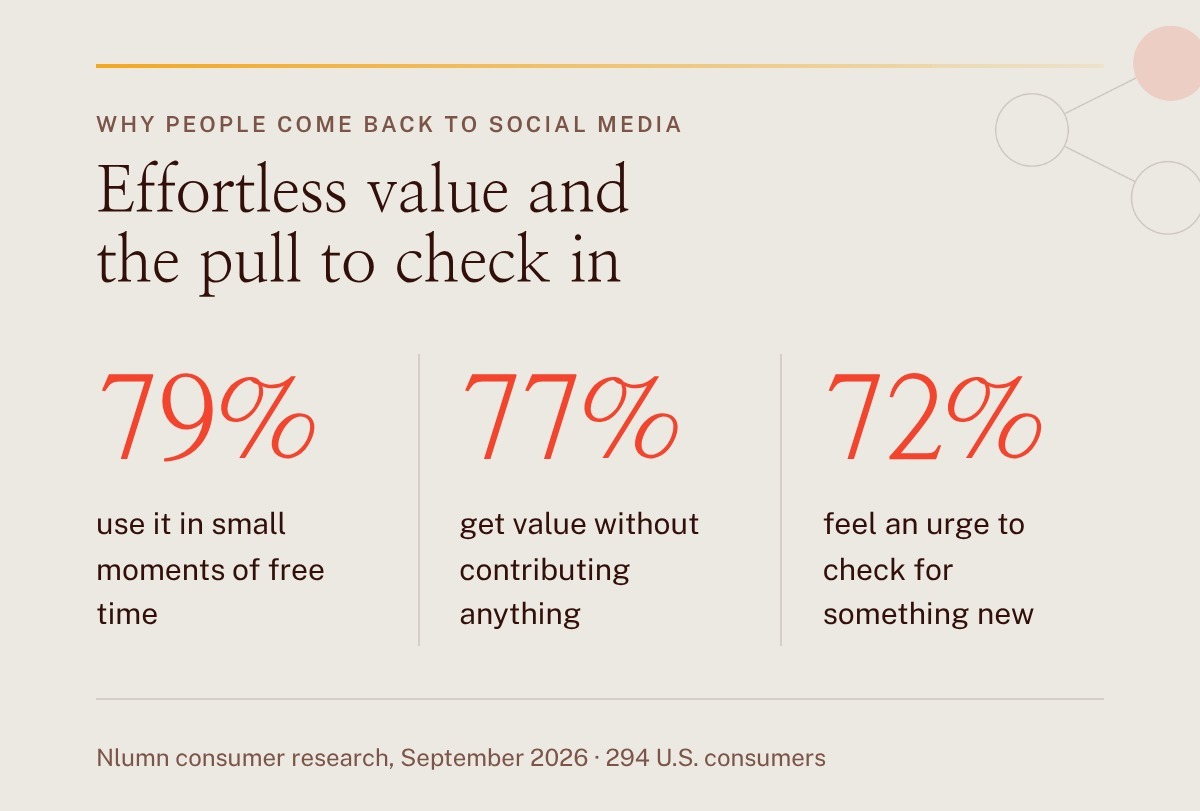
Social media provides immediate value with minimal effort. The anticipation of discovering something new, finding inspiration, or connecting with others gives people additional reasons to return.
Social media’s advantage may instead be in creating anticipation and a reason to check back without a specific goal. But that pull comes with a trade-off. More than three-quarters of respondents said they sometimes spend longer on social media than intended.
For health and wellness companies, the opportunity is to make useful insights, timely feedback, and meaningful progress just as accessible through purposeful engagement.
What Actually Keeps Consumers Using Health Apps?
Specific health goals may motivate users to start using a health app. Continued use appears to depend on how well that app fits into everyday life and helps users recognize progress.
Three practical benefits stood out as important for continued use: being part of a daily routine, ease of use, and the visible progress toward goals.
Among regular health app users, 41% cited being part of their routine as a reason they continue using an app, compared with 28% of occasional users. Regular users were also more likely to say that reaching a specific goal kept them engaged.
Yet an important gap remains. While health apps deliver relatively well on tracking, accountability, and fitting into daily routines, consumers report less consistent support on staying motivated, building healthier habits, and achieving meaningful health goals.
In other words, helping someone track their behavior is not necessarily the same as helping them change it.
The Opportunity: Design for Lasting Value, Not Just Repeat Visits.
For companies developing digital health and personalized nutrition solutions, these findings suggest an opportunity to rethink how engagement is defined and measured. Rather than focusing on how often consumer return to the app, we should consider how each interaction helps users make progress toward their health goals. That means designing solutions that reduce the effort required to take action, providing feedback that helps people align with behaviors and visualize progress, or adapting recommendations as their needs and circumstances change.
This last point is especially important in personalized nutrition, where even sophisticated biological insights may have limited impact if recommendations are not actionable, aligned with individual behaviors, or adaptable. A solution that works initially may lose relevance if it cannot adapt as a person’s goals and circumstances evolve.
Ultimately, sustained engagement is not simply about creating a stronger urge to return. It is about giving people something worth returning for.