Over the past two months, we've explored two important dynamics shaping personalized nutrition. Consumer interest is high, but participation remains limited. And when consumers do engage, many are building their own solutions by combining products, tools, and services.
This month, we looked at what happens after consumers get started. What we found points to a critical inflection point: while consumers are willing to begin personalized nutrition programs, many are not staying engaged over time.
The Six-Month Wall
More than half of consumers currently using a personalized nutrition plan have been on it for six months or less. Retention challenges are not unique to personalized nutrition. In the health and fitness app category, benchmark data shows that only 4% of users are still active after 30 days.
In that light, six months of engagement is relatively strong. But this may not be long enough to deliver health outcomes for consumers or to create a sustainable business model. As an example:
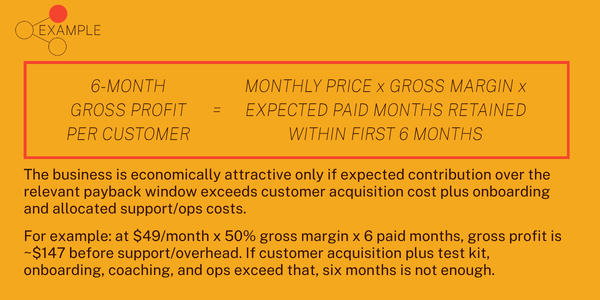
The conversation needs to shift from acquisition to retention. This includes understanding what drives it, and what causes it to break down.
"It Worked, Until It Didn't"
Cost is often cited as the primary reason consumers stop using personalized nutrition plans. Companies looking to increase costs to improve margins are likely going to struggle with that strategy, as well as limit consumers who could otherwise benefit from your program but can't afford it.
As we shared in February, it's not just about the cost; it's about the value that people receive from personalized programs. There are a number of underlying drivers of value that are more nuanced. Many consumers report that their plans either didn't work or that it worked for a period of time and then stopped delivering results. This suggests that the challenge is not just about getting started, but about maintaining relevance and effectiveness.
Why Sustained Engagement Is Challenging
Many factors can contribute to challenges in keeping customers. Some common complaints:
- Solutions don't feel personal. Services consider individual biological measures but don't fit into individual behaviors, preferences, or goals.
- Products are heavy on data, weak on guidance. Consumers are left to interpret their own data, evaluate multiple inputs, and make ongoing adjustments without clear guidance. Over time, this can create friction—especially when results are unclear or inconsistent.
- Plans fail to adapt to changing needs. When needs evolve, whether due to changing goals, new health information, or shifting routines, prior recommendations may no longer work. When that happens, perceived value declines, and disengagement often follows.
Sustaining Engagement
Here are some ways companies can work together to address the factors limiting retention.
- Personalize the experience, not just the recommendation. Programs should combine biological data with psycho-behavioral factors: motivations, habits, routines, social context, barriers, and preferred support style. One approach could be to create adaptive personalized nutrition systems tailored to the type and timing of personalized advice for individual needs and capabilities in real-life food environments.
- Turn data into guided next steps. Help consumers interpret data they may already be collecting, including biomarker, wearable, app, and product data on their own. The strongest models will help translate inputs into clear "what to do next" guidance.
- Build adaptive systems that recalibrate over time. Retention depends on maintaining relevance as goals, routines, health status, and results change. Products should include structured check-ins, progress interpretation, goal adjustments, and "plan B" logic when progress stalls.
- Blend technology with credible human support. AI, apps, and wearables can scale personalization, but trust and behavior change often require human reassurance, especially when results are unclear or health needs become complex.
Marketplace winners will likely be those that reduce consumer uncertainty. This means transparent evidence, explainable recommendations, privacy controls, professional validation, and, importantly, partnerships across food, supplements, diagnostics, healthcare, and coaching. Success may depend less on standalone solutions and more on reducing friction, improving clarity, and helping consumers continue to see progress over time.

The Partnership Imperative
If retention is the central challenge, it may not be something any single solution can solve on its own.
Supporting long-term engagement may require a more connected approach that brings these elements together more cohesively. Personalized nutrition is becoming an ecosystem business, not a single-company product category. The hard part is that the consumer experience has to feel simple, but the system behind it is complex. The most valuable partnerships will connect insight to action: turning biological and behavioral data into trusted, practical next steps that fit into daily life. Companies should focus on what they uniquely do well, then partner to fill the gaps needed to improve consumer confidence, reduce friction, and sustain engagement.
For partnerships, this means several things:
- Partnerships should be built around user capability gaps. A food company may be strong in products, distribution, and consumer communication, but weak in diagnostics, clinical interpretation, and data integration. A diagnostics company may manage data and generate clinical insights but lacks food and nutrition solutions or effective communication for users to act. The partnership question becomes: What must be true for the consumer to make progress, and which partner is best positioned to own that capability?
- Retail, food service, and product partners have a key role because this is where insight meets behavior. Guidance is only useful is consumers can act on it in their daily environment. Partnerships with grocery, meal delivery, food brands, and supplement companies can turn recommendations into purchasable foods, meal plans, and default choices. Further partnerships with employers, insurers, and community organizations can support incentives, accessible routines, and accountability.
- Healthcare and professional partners become a trust infrastructure. Consumers may explore products digitally, but confidence often depends on credible interpretation and recommendations. In personalized nutrition, that supports hybrid models where AI and apps scale the experience, while dietitians and other health care professionals provide oversight and credibility.
- Data partnerships are foundational. Personalized nutrition depends on combining biological, clinical, wearable, food, purchase, and contextual data. Progress requires standardization, secure data sharing, data fusion, privacy protection, and transparent governance. Strong partnerships need to consider governance architecture early, not after the commercial model is already set.
In this context, success may depend less on building standalone solutions and more on reducing friction, improving clarity, and helping consumers continue to see progress over time.