The 2025-2030 Dietary Guidelines for Americans (DGA) are intentionally designed to be simpler, more flexible, and broadly applicable. As the primary public-facing nutrition guidance in the U.S., they will shape federal food programs, healthcare conversations, consumer expectations, and product innovation for years to come. The new DGA raises a critical strategic question for companies operating in nutrition and health: Has the shift toward more generalized guidance moved us further away from the personalization required to improve health outcomes, affordability, and long-term adherence?
The new DGA highlight a small number of healthy dietary patterns and encourages consumers to adapt guidance to their preferences, culture, and budget.
This represents a shift from previous DGA, which detailed more opportunities for greater personalization of dietary patterns across life stages and use cases. In the current DGA, the need for personalization is less clearly articulated.
That said, it also creates an opportunity for the food industry to deliver personalized, affordable, and actionable nutrition solutions.
Personalization remains important—even if public guidance de-emphasizes it.
While sub-group-specific messaging is less prominent in the new DGA, nutritional needs still differ by life stage, health status, and risk profile.
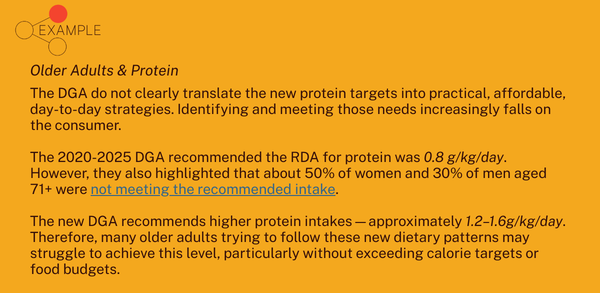
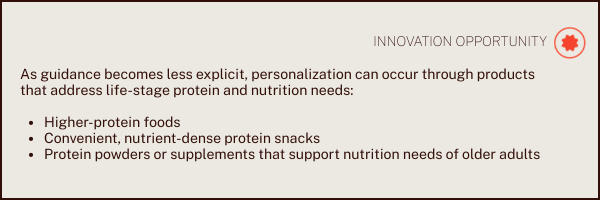
Less specific guidance further increases the risk that recommendations will not be met.
Specific guidance helps healthcare professionals and policymakers translate recommendations into nutrition programs and eating plans. It also helps individuals better understand what to change, why it matters, and how to do it. In contrast, less specific guidance can create confusion and make guidance difficult to follow, especially if recommendations seem to conflict with each other.
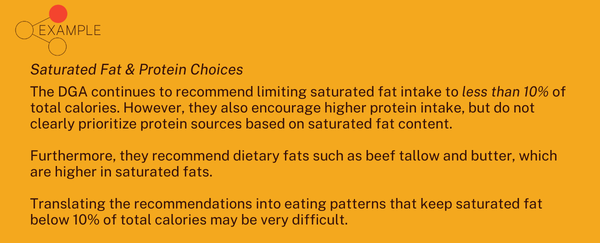
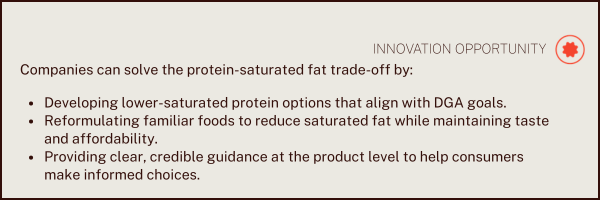
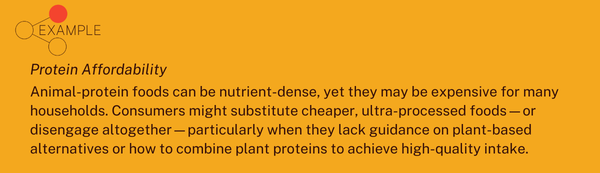
Affordability: flexibility does not equal access.
The DGA emphasizes flexibility and choice, but it does not answer a fundamental consumer question: Can I afford to eat this way consistently?
Neither the DGA nor the accompanying Scientific Foundation provides economic modeling to show what recommended eating patterns actually cost, how affordability varies by income or region, and where trade-offs occur between nutrient quality, cost, and convenience.
Affordability and convenience are not optional, they are necessary to improve public health.

Reframing processed foods from liability to leadership opportunity.
The food industry is often criticized for its role in the proliferation of "ultra-processed foods" (UPFs)—and that criticism is shaping public perception, regulations, and trust.
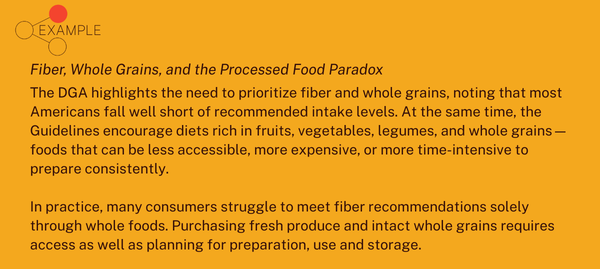
However, most people rely on packaged, processed, and prepared foods to meet their needs as many of these foods are convenient, affordable, and shelf stable.

Industry's expanding role: translating guidance into products and services.
The new DGA aims to make healthy eating feel simpler and more inclusive. In doing so, they have shifted greater responsibility for personalization, affordability, and adequacy onto individuals—many of whom lack the resources to self-optimize.
For industry leaders, this creates both responsibility and urgency. The DGA defines what is broadly acceptable, not what is optimal for every individual. As guidance becomes more generalized, complexity does not disappear, but it shifts.
Industry increasingly serves as the translator between generalized guidance and products that can support individual goals. The companies that succeed will:
- Respect biological, demographic, and behavioral differences.
- Design for affordability and real-world adherence.
- Use science to guide—not overwhelm—consumer choice.
- Reposition processed foods as tools for health.
- Provide tools, such as digital platforms to help people make better choices and enable personalization to be practical at scale.
As public guidance simplifies, the role of industry in supporting healthier choices only grows.