The U.S. is moving closer to a federal definition of ultra-processed food (UPF). In July 2025, the U.S. Food and Drug Administration (FDA) and U.S. Department of Agriculture (USDA) asked for public input on how UPFs should be defined, without proposing a definition. On August 3, 2026, FDA submitted a White Paper: Proposed Definition of Ultra-Processed Food for White House review. It remains under review at the Office of Information and Regulatory Affairs (OIRA), and its details have not been released publicly.
The definition is important because it could influence dietary guidance, procurement and nutrition programs, product development, consumer communications, and future regulation. More fundamentally, it raises a question: Is a federal UPF definition primarily a measure of processing, or is it also classifying foods based on formulation, ingredients, nutritional quality and ultimately healthfulness? In this first installment, we examine how different ways of defining UPF place varying emphasis on processing, formulation, and healthfulness, where those concepts overlap, and what the current evidence does and does not tell us about UPFs and health.
Processing, formulation, and health are not the same thing.
NOVA, the classification system most commonly used in UPF research, describes ultra-processed foods based on the nature, extent, and purpose of processing. For packaged foods, an approach to identifying NOVA Category 4 foods is to examine ingredient lists for substances rarely or never used in home kitchens or for additives used to modify sensory characteristics (Monteiro et al., 2019). Healthy Eating Research recently recommended NOVA Category 4 as the scientific definition of UPF in U.S. policy, operationalized by the presence of at least one cosmetic additive or ingredient of non-culinary use.
Other groups take different approaches. The Center for Science in the Public Interest (CSPI) emphasizes characteristics linked to health concerns, including nutrient profile, calorie density, refined carbohydrates and certain ingredients. The Institute of Food Technologists (IFT) and Institute for the Advancement of Food and Nutrition Sciences (IAFNS) emphasizes distinguishing processing from formulation and nutritional quality.
These approaches to defining ultraprocessed foods point to different dimensions which can create confusion.
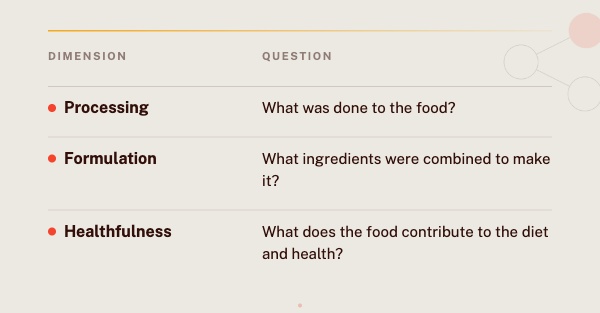
A food can undergo substantial industrial processing and still have a simple formulation. Conversely, a conventional processed product can contain refined ingredients, isolates, flavors, emulsifiers or sweeteners that make it highly formulated. If ingredient lists become the primary way to identify UPFs, we may be defining formulation more than processing. Add nutrient thresholds, and the definition may move closer to healthfulness.
FDA already has a regulated "Healthy" nutrient-content claim based on recommended food groups and limits for added sugars, saturated fat and sodium. Yet the Dietary Guidelines for Americans, 2025-2030 (DGA) also tell Americans to limit highly processed foods, while the scientific foundation provisionally describes these foods partly in terms of refined or extracted ingredients and industrially manufactured chemical additives.
The frameworks are beginning to overlap. There are practical reasons for developing a UPF definition rather than simply expanding "healthy." FDA's healthy definition is a voluntary positive labeling claim, while a federal UPF definition could support research, dietary guidance, procurement, nutrition programs and future policy. For consumers and companies, however, overlapping definitions could increase confusion about whether a food is nutritious, highly processed, both, or neither. Furthermore, should UPF be considered a proxy for healthfulness?
UPF and health.
Large prospective cohort studies have reported that higher UPF consumption is associated with greater risk of cardiovascular disease, some cancer outcomes, mortality and type 2 diabetes (Srour et al., 2019; Fiolet et al., 2018; Rico-Campa et al., 2019; Chen et al., 2023). These observational studies are important, but they cannot establish causation. Classification can also be imperfect when dietary assessment tools were not designed to distinguish foods by NOVA processing categories (Fang et al., 2024).
Studies examining whether nutritional quality accounts for these associations have produced different results. In the Italian Moli-sani cohort, higher UPF intake remained associated with all-cause and cardiovascular mortality after accounting for the nutrient profile of the diet, suggesting that poorer nutrient composition did not statistically explain the association (Bonaccio et al., 2022). In contrast, an analysis of two large U.S. cohorts found only a modest association between total UPF intake and all-cause mortality, no association with cardiovascular or cancer mortality, and a stronger relationship between overall dietary quality and mortality (Fang et al., 2024). Differences in population, dietary assessment, UPF measurement, nutritional quality measures, and foods consumed may help explain the different findings.
Associations also vary by food category. In three large U.S. cohorts, some refined breads, sweetened beverages and ready-to-eat mixed dishes were associated with greater type 2 diabetes risk, while some ultra-processed cereals, whole-grain breads and yogurt-containing categories were associated with lower risk (Chen et al., 2023). Similar variation has been reported for cardiovascular disease: processed meats and sugar-sweetened beverages were among the categories associated with greater risk, while some bread, cereal, and yogurt-based categories showed inverse associations (Mendoza et al., 2024).
Controlled trials are beginning to clarify what may drive these differences. In a 2019 National Institutes of Health (NIH) inpatient trial, 20 adults consumed ultra-processed and unprocessed diet for two weeks each. Participants consumed about 500 kcal/day more on the UPF diet and gained about 0.9kg, while losing a similar amount on the unprocessed diet. The diets were not identical, and the authors identified energy density, food texture, eating rate, and possibly protein leverage as potential contributors. A smaller 2024 randomized inpatient crossover study in nine Japanese men found about 814 kcal/day greater energy intake and 1.1 kg greater weight gain during the UPF period, along with fewer chews per calorie. The short diet periods and small sample limit interpretation, but the findings add direct experimental evidence of different short-term eating and weight responses (Hamano et al., 2024).
In a 2025 randomized crossover trial, both a minimally processed diet and a UPF diet followed the United Kingdom's Eatwell Guide. Participants lost weight on both over eight weeks, but more on the minimally processed diet, 2.06% versus 1.05%. They also reported consuming about 327 fewer kcal/day on that diet. The UPF diet was more energy dense, 1.60 versus 1.25 kcal/g, and rated more favorably for flavor and taste. The results suggest that overall diet quality remains relevant, while the difference in weight loss suggests dietary guidance may not fully account for differences between the diets.
A 2026 randomized crossover trial testing food texture and eating rate within diets composed almost entirely of UPFs. Participants consumed two 14-day diets closely matched for non-beverage energy density, energy offered, portion size, variety, liking and familiarity. Eating rate was about 43% slower on the slower-texture diet, and participants consumed 369 fewer kcal/day, with similar appetite ratings. The findings suggest that food texture and the eating behaviors it produces, rather than UPF classification alone, may be important determinants of energy intake.
Taken together, diets high in UPFs are associated with poorer health outcomes at the population level, but associations vary across foods and food categories. Controlled trials suggest that overall diet quality, energy density, food texture and eating rate can materially influence short-term energy intake and weight outcomes even when foods remain classified as ultra-processed. Other effects related to formulation, refinement, additives, and the food matrix remain possible, but human experimental evidence is less developed.
What does this mean for policy and industry?
In Part 2, we will translate these scientific and policy questions into practical implications for food, nutrition and ingredient companies, including considerations for portfolio exposure, product development, personalized nutrition and how organizations can prepare for multiple plausible policy outcomes.