Working with influencers, or "creator marketing," has become one of the primary ways brands reach customers, and increasingly, one they cannot afford to skip. The global creator economy is projected to double to $480 billion by 2027, and U.S. spend alone is expected to reach $12.17 billion in 2026.
Nearly three-quarters of brands are shifting budget toward creators because creator content often performs where traditional brand-led content struggles: trust, education, relevance, and conversion.
This can be especially important for personalized nutrition, a category where consumers are not just buying a product. They are making an informed, trust-based decision about their health and wellness. They need to understand why a solution fits them, not just why it worked for someone else.
Creator marketing can be an especially powerful tool for personalized nutrition brands, but only when it is guided by the right strategy. When done well, creators can help brands drive engagement, build credibility, and move customers into a more personalized journey that increases customer lifetime value and improves health outcomes. Without the right creator-brand fit, creator marketing becomes a generic pitch in a new format.
How Brands Are Working with Creators Right Now
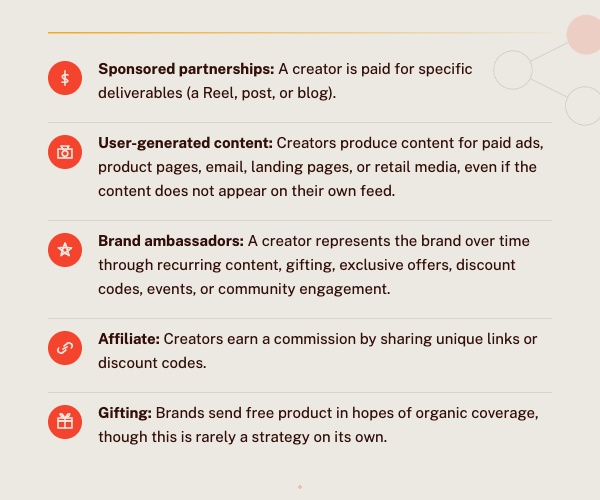
Creator marketing can take several forms, depending on budgets and goals:
The most effective partnerships come from creators who have genuinely used and loved the product or service, or who have real authority in the niche you're trying to serve.
Without that fit, the brand loses the trusted influence with a targeted audience that makes creator marketing work in the first place.
The Personalized Paradox: Why "Follow Me" Doesn't Mean "Copy Me"
Personalized nutrition brands face a unique challenge in creator marketing. The category is built on the idea that there is no universal answer. The right product, plan, or protocol depends on a person’s biology, goals, lifestyle, preferences, and constraints.
In contrast, traditional influencer marketing works by inviting audiences to follow one person’s routine.
This paradox must be managed as it can either weaken the message or become the strategy.
The strongest creator partnerships in personalized nutrition do not ask an audience to copy the creator. They use the creator as a trusted entry point into an individualized journey. The creator’s role is not to say, “This worked for me, so it will work for you.” It is to say, “This helped me understand what I needed to do, and here is how you can find what is right for you.”
A personalized nutrition brand should brief creators to share their own experience as one example, not a universal prescription. The content should consistently move the audience from inspiration to assessment (i.e., take the quiz, review the data, understand your goals, consult the right expert, or build a plan based on your own inputs.)
In this way, a creator strategy becomes more than media buying. The creator becomes a credibility layer, an education layer, and a conversion bridge between broad consumer interest and a personalized product experience.
ROI vs. Reach
The current top ROI drivers are boosting creator posts through paid media, branded sponsored posts, and affiliate marketing. Across the board, 69% of marketers say creator content outperforms brand-directed content in ads.
Before spending a dollar, brands need to define the goal: awareness, education, lead generation, conversion, retention, or some combination. The best creator programs define success upfront. The metrics should match the business objective.
Too often, creator programs are evaluated on the wrong metric. Reach and views may look strong without moving the customer toward purchase. In personalized nutrition, this matters because the customer journey is usually more considered than an impulse purchase.
In personalized nutrition, engagement matters far more than follower count. A creator with genuine authority can move the right customer further than a generalist with a larger following, especially when that creator can explain the “why” behind a product or service, not just the “what.”
What Is Holding Brands Back
One of the biggest challenges is the personalized paradox. A brand built on “there is no one-size-fits-all” can undermine its own message if it highlights one person’s routine as the answer for everyone.
There's also a lack of a clear creator strategy. Too many brands work with creators because their competitors are doing it or because a creator has a large audience. That approach may generate content, but may not generate growth.
Before selecting creators, a strong strategy should answer several questions:
- Who is the target customer?
- What problem are they trying to solve?
- Which creators have credibility with that audience?
- What role should the creator play?
- Where should the customer go after seeing the content?
- How will we measure whether the partnership worked?
Personalized nutrition brands also have a higher bar for compliance and credibility. Content should not be treated like ordinary lifestyle content. Health-adjacent claims need to be carefully briefed, substantiated, reviewed, and measured.
The goal is not to make creator content feel scripted; it is to protect both authenticity and accuracy.
Creator marketing is also a moving target. Platforms constantly change their algorithms and formats, so what worked last quarter may not work now. Tracking success means adapting to what is performing, which requires dedication and understanding, not just a strategy you can learn once and put on autopilot.
Creators That (May) Matter Most
Not every creator plays the same role. Personalized nutrition brands should evaluate creators by strategic function, not just by audience size.
- Credentialed experts can build trust and explain the science. These may include registered dietitians, physicians, researchers, pharmacists, performance nutritionists, and other qualified professionals.
- Lived-experience creators can make the category relatable. They help audiences understand what it feels like to navigate a health goal, habit change, dietary shift, or product experience.
- Lifestyle creators can show how the product fits into daily routines, meals, travel, family life, fitness, work, or aging well.
- Community creators can reach audiences with specific needs, values, or identities, such as endurance athletes, busy parents, women in midlife, plant-based consumers, GLP-1 users, metabolic health communities, or biohacking audiences.
The best programs often use a mix of these creator types. The mistake is expecting one kind of creator to do every job.
Where Creator Content Goes Next
Creator content is no longer just for social media. It can become the content engine for your landing pages, product pages, email, paid ads, in-person events, sales materials, and customer education. A single collaboration can be repurposed across the entire funnel, so one partnership with a credentialed expert can build authority across multiple platforms and audiences at once.
Another shift to watch is in commerce, where the path from discovery to purchase is shortening with platforms like TikTok Shop and affiliate linking. Brands that build shoppable, trackable creator strategies will capture that demand faster than those still treating creators as awareness alone.
For personalized nutrition brands, that creates both opportunity and risk. A faster path to purchase can improve conversion, but only if the customer still understands why the product or service is right for them.
What Personalized Nutrition Brands Should Do Now
- Choose fit over reach. A creator with genuine authority in your niche will move the right customer further than a generalist with a larger following. Engagement and credibility matter more than follower count.
- Use creators as guides, not templates. The message should not be “do what I do.” It should be “discover what works for you.” That distinction protects the personalized promise.
- Lead with credibility. In a category built on science, credentialed creators are a valuable trust-building asset.
- Build relationships, not one-off posts. Long-term partnerships compound trust and give a single collaboration more room to work across your website, email, and ads, not just social media.
- Brief for compliance and clarity. Nutrition and health-adjacent claims need guardrails. Creators should understand what they can and cannot say, and how to keep the message both authentic and accurate.
- Measure for the full funnel. Decide upfront whether the goal is reach, education, leads, conversion, subscription, retention, or repeat purchase. Then track performance through creator-specific landing pages, quiz starts, email capture, discount codes, affiliate links, paid amplification, CRM data, and cohort performance.
The Bottom Line for Personalized Nutrition
For personalized nutrition brands, the opportunity is not to chase the creator with the largest audience. It is to build a creator system that turns trust into education, education into first-party data, and first-party data into a more personalized customer journey.
That requires more than finding influencers. It requires knowing which audiences matter, which creators can credibly reach them, which messages are compelling and compliant, and which conversion paths prove the program is working.
The brands that treat creators as a credibility and education engine, matched carefully to the problem they solve, will build something durable. The brands that only chase reach will be paying for attention that does not convert.